






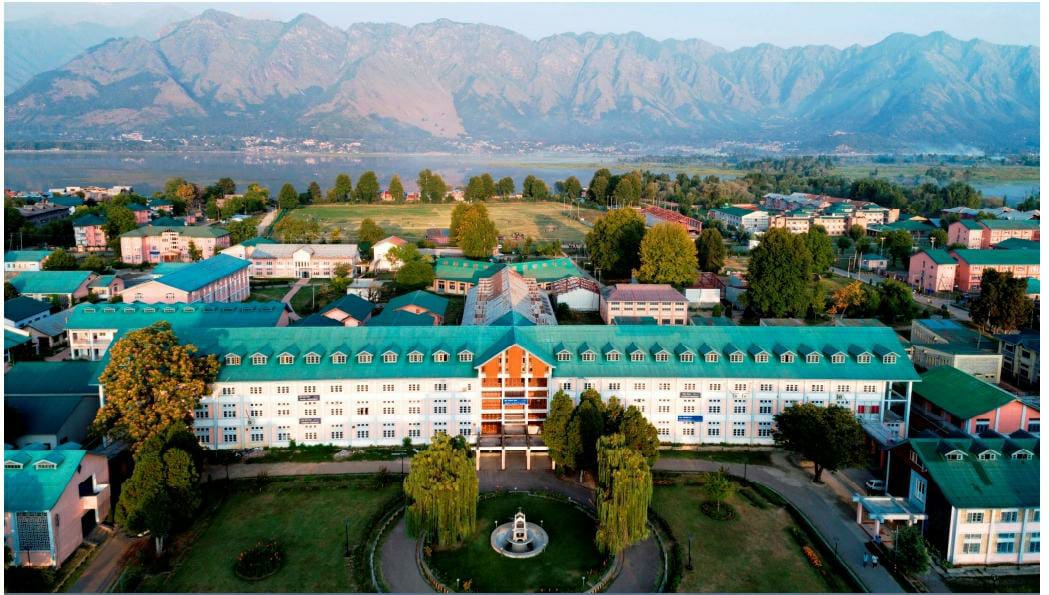
Srinagar: The National Institute of Technology (NIT) Srinagar has secured the 32nd position among engineering colleges in India in the India Today Rankings 2025, improving slightly from 33rd place in 2024.
In the category of Government Engineering Colleges, the institute retained its 23rd rank, while among Top Technical Universities in India, it rose to 22nd, up from 21st last year.
NIT Srinagar scored 23 in both Admissions & Student Quality and Placement & Career Progression, reflecting the high calibre of its students and the institute’s effective career support. In other key areas, the institute achieved scores of 191.2, 190.2, 176.6, 92.6, and 184.9, demonstrating its strengths in academics, research, infrastructure, and student development. The overall score across all parameters was 1369.2, including a cumulative benchmark of 533.7, underlining the institute’s commitment to quality education and holistic student growth.
Director of NIT Srinagar, Prof. Binod Kumar Kanaujia, described the ranking as a proud moment for the institute. He noted that over the past year, NIT Srinagar has focused on enhancing laboratory facilities, updating curricula, and encouraging students to pursue innovative projects.
“These initiatives, along with our faculty’s active participation in national and international research and conferences, have significantly contributed to our improved ranking. This achievement motivates us to maintain and surpass this performance in the coming years,” Prof. Kanaujia added.
Registrar Prof. Atikur Rehman said the rankings reflect the institute’s dedication to academic and institutional excellence. “It encourages us to further strengthen administrative processes and provide enhanced support to both faculty and students,” he stated, also commending the NIRF team for their exemplary work during the survey.
Chairman NIRF, Prof. Babar Ahmad, acknowledged that the achievement belongs to every student, teacher, and staff member who contributes to making NIT Srinagar a hub of learning and innovation.
Meanwhile, NIRF Coordinator Dr. Vijay Kumar highlighted the upgrades in labs, revised curricula, and encouragement of creative student projects over the past year. “These steps, combined with active faculty research, have been key to this recognition and motivate us to aim even higher in the future,” he said, expressing gratitude to the Director, Registrar, and the entire NIRF team for their guidance. He also appreciated Prof. Babar Ahmad and Junior Assistant Ajay Kumar for their dedicated efforts in compiling and submitting the required data.