







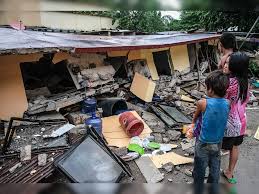
MANILA: At least 69 people have died following a powerful earthquake that struck central Philippines on Tuesday night.
The magnitude-6.9 quake, which struck around 10 p.m., caused widespread destruction in the city of Bogo and surrounding rural towns in Cebu province. Collapsed homes, nightclubs, and businesses trapped an unknown number of residents, prompting a large-scale rescue operation. Army troops, police, and civilian volunteers, aided by backhoes and sniffer dogs, conducted house-to-house searches for survivors.
The quake originated from an undersea fault just 5 kilometers below the surface, about 19 kilometers northeast of Bogo, a coastal city of roughly 90,000 people, where around half of the fatalities occurred. Officials warned that the death toll in Bogo is likely to rise as rescue efforts are slowed by rain and damaged roads and bridges.
“We’re still in the golden hour of our search and rescue,” said Bernardo Rafaelito Alejandro IV, deputy administrator of the Office of Civil Defence. “Reports indicate many people are still trapped under debris.” The Philippine government is evaluating whether to request international assistance based on a rapid damage assessment.
In a mountain village, landslides and falling boulders blocked access, and authorities struggled to bring in a backhoe to assist in rescue operations, Bogo disaster-mitigation officer Rex Ygot said. Some survivors have been transported to nearby hospitals, according to Glenn Ursal, another disaster-mitigation officer.
Deaths were also reported in Medellin and San Remigio, including three coast guard personnel, a firefighter, and a child. Some were killed while fleeing a sports complex during the quake.
The earthquake, one of the strongest to hit central Philippines in over a decade, struck at night while many residents were asleep. The Philippine Institute of Volcanology and Seismology briefly issued a tsunami warning for Cebu, Leyte, and Biliran, anticipating waves up to 1 meter, but no significant waves were reported and the warning was lifted after three hours. Thousands of residents stayed outdoors overnight despite intermittent rain.
Cebu and surrounding provinces were still recovering from a tropical storm last Friday that left at least 27 people dead, caused widespread power outages, and forced tens of thousands to evacuate.
Schools and government offices remain closed while structural safety checks are carried out. Over 600 aftershocks have been recorded since Tuesday night’s quake, raising concerns over landslides in rain-soaked areas.
“This was really traumatic for the people,” said Teresito Bacolcol, director of the Philippine Institute of Volcanology and Seismology. “They’ve endured a storm and now this devastating earthquake.”
The Philippines, located on the Pacific “Ring of Fire,” is highly vulnerable to earthquakes, volcanic eruptions, and around 20 typhoons each year.