






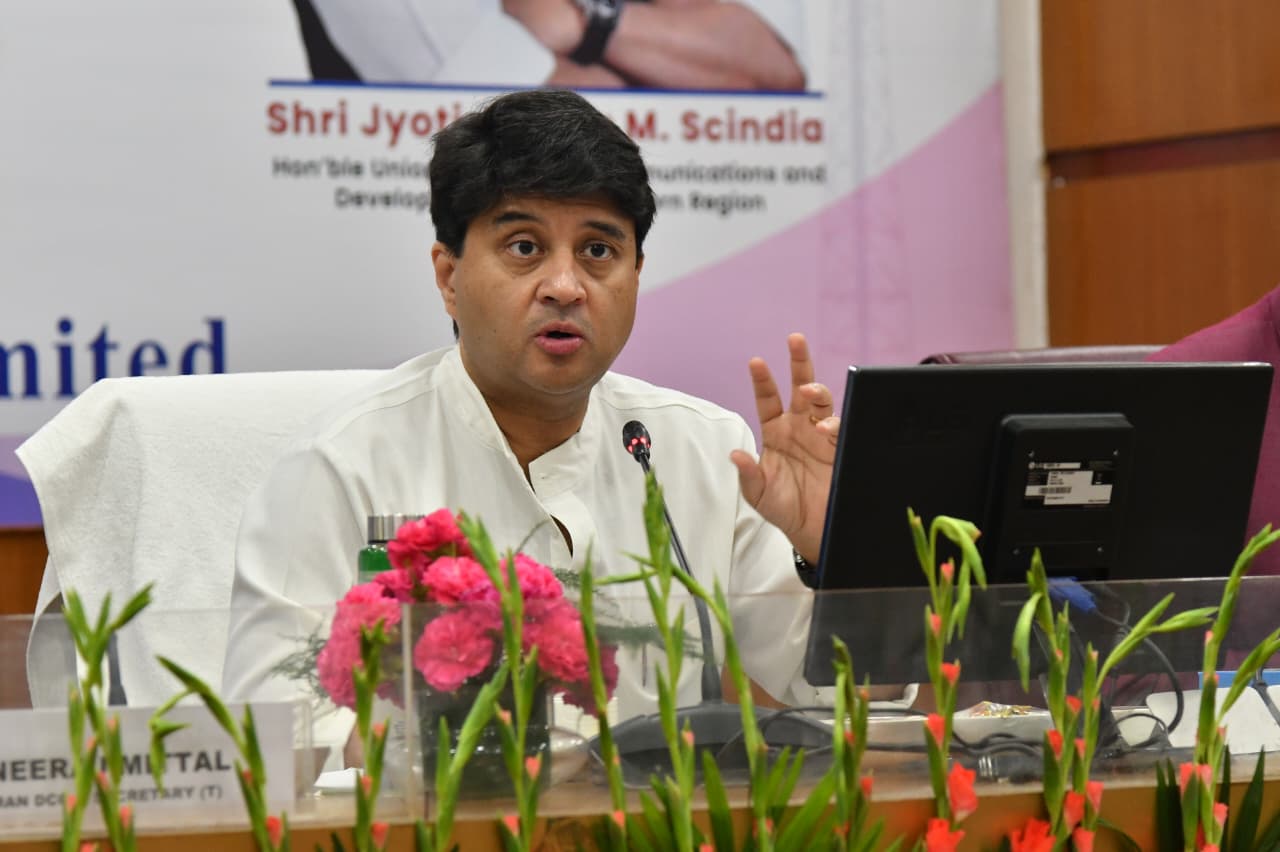
New Delhi: Union Communications Minister Jyotiraditya Scindia announced on Friday that Prime Minister Narendra Modi will launch two major initiatives on September 27: BSNL’s indigenous 4G stack and the country’s 100% 4G saturation project under the Digital Bharat Nidhi scheme.
Scindia said the 4G stack will be rolled out across nearly 98,000 sites nationwide, covering every part of the country. “Our 4G towers and BTSs already serve 22 million customers. It is fully software-driven, cloud-based, future-ready, and can seamlessly upgrade to 5G,” he stated.
He noted that BSNL is spearheading government projects to extend connectivity to uncovered villages, particularly in rural and underserved areas, under the 4G Saturation Scheme.
Highlighting India’s growing telecom manufacturing ecosystem, Scindia said global companies are increasingly partnering with Indian manufacturers. “Cisco has tie-ups with Flex, Ericsson, and VVDN in Jabil, while Dixon is expanding here. India is gradually becoming a hub for telecom equipment manufacturing, not just service delivery,” he added.
The minister also emphasized the expanding role of C-DOT, which now produces Radio Access Network (RAN) equipment alongside Tejas Networks. “This equipment has a large market, particularly in the Global South. These firms are responsible for packaging solutions, as they have successfully done for BSNL,” he explained.
Regarding BSNL’s future, Scindia said a capital expenditure plan is in place to expand sites and modernize infrastructure, with funding from free cash flows, land monetization, and central support, though he withheld further details.
On tariffs, he stressed that pricing is left to individual operators. “India offers the cheapest telecom services globally, with data costing just 11 cents per GB compared to $2.49 worldwide. ARPUs and packages are determined by companies in a competitive market; regulation is unnecessary,” he said.
Scindia also highlighted that BSNL reported profits in two quarters, but urged stakeholders to focus on operating profits and EBITDA, noting the impact of depreciation after a record ₹25,000-crore capital expenditure in FY24-25.
“These initiatives will not only extend digital access to every village but also mark a new chapter in India’s emergence as a global telecom manufacturing leader,” he concluded.