






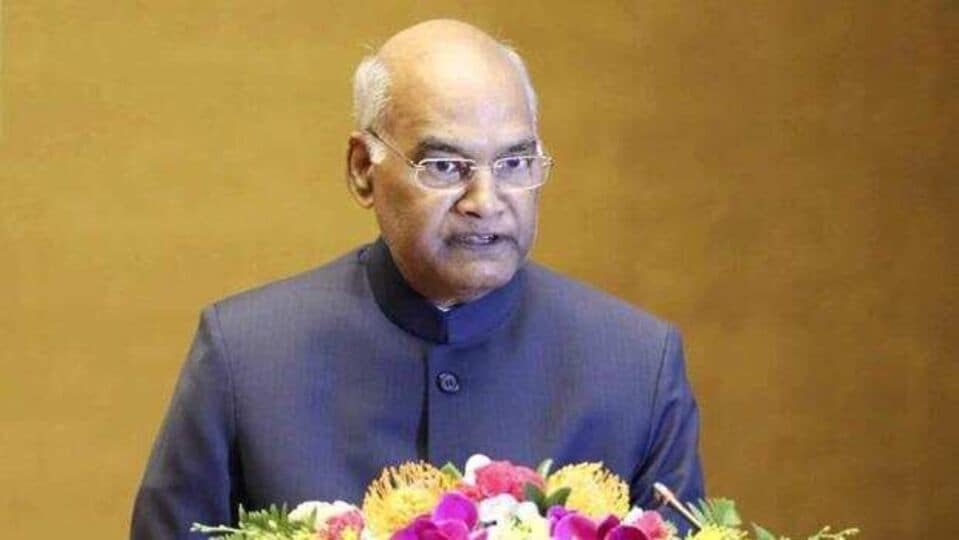
New Delhi: Former President Ram Nath Kovind on Thursday warned that rapid advances in technology and accelerating climate change are giving rise to new human rights challenges — especially for informal sector workers and communities facing climate-induced displacement.
“Economic progress must always walk hand in hand with human dignity,” he said, stressing that climate change has evolved from being merely an environmental concern to becoming “a human rights imperative.”
Speaking at the 32nd Foundation Day of the National Human Rights Commission (NHRC) and the National Conference on Human Rights of Prison Inmates, Kovind said that India’s development should be assessed not only by economic growth but also by how well it protects the dignity and welfare of its most vulnerable citizens.
He noted that while India has built a robust constitutional and institutional framework to safeguard human rights, lasting progress depends on empathy, inclusion, and moral conviction.
“Human rights are not just statutory entitlements but expressions of a deeper moral and civilisational consciousness,” he said, adding that India’s cultural heritage — rooted in dharma (duty), karuna (compassion), and nyaya (justice) — continues to guide its pursuit of human dignity.
Applauding the NHRC for being a “voice to the voiceless” over the past three decades, Kovind lauded its work in addressing custodial justice, bonded labour, human trafficking, and the rights of women, children, and persons with disabilities — efforts that, he said, “have left a lasting imprint on the nation’s conscience.”
On prison reforms, the former President asserted that any form of violence or inhuman treatment of those in custody violates both constitutional principles and moral values. He urged authorities to build gender-sensitive and child-friendly correctional systems, viewing prisons as spaces for reform, rehabilitation, and hope rather than punishment.
Kovind also emphasised that mental health is a human right, calling for an end to stigma around mental illness. “Emotional and psychological well-being is as important as physical health,” he said, praising NHRC’s initiatives promoting community-based mental health care.
Delivering the keynote address, NHRC Chairperson Justice V. Ramasubramanian said the Commission has handled around 24 lakh cases since its inception in 1993 and awarded ₹263 crore in compensation across 8,924 cases. In the last year alone, NHRC registered 73,849 complaints, took suo motu cognisance of 108 matters, and resolved 38,063 cases.
“The Commission strives to uphold the standards set by its illustrious predecessors and meet the expectations of victims of human rights violations,” he said, noting NHRC’s focus on Dalit rights, tribal welfare, mental health, and custodial deaths.
Justice Ramasubramanian added that the NHRC is deepening collaboration with human rights institutions across the Global South, with several nations seeking partnerships.
In his welcome address, NHRC Secretary General Bharat Lal described the Commission as the “conscience keeper of human rights” in India’s democracy. He highlighted the Commission’s digital initiatives like HRCNet, which enables people — even in remote areas — to file complaints in 22 Indian languages and track them online, making justice more accessible.
“Prisons should not be seen merely as places of punishment but as institutions for learning, rehabilitation, and transformation,” Lal said.
He added that the NHRC is actively working on issues like manual scavenging, beggary, and hazardous labour, while prioritising capacity building of police and correctional officers to foster empathy and accountability.
Referring to India’s unopposed re-election to the UN Human Rights Council (2026–28), Lal said the achievement reflects India’s unwavering commitment to human rights and its expanding global leadership in the field.
“Human rights cannot rest on institutions alone,” he concluded. “It is a shared moral duty of the government, civil society, and every citizen to ensure that no one is left behind — and that every individual lives with dignity and without fear.”