






Brussels: Pro-Palestinian protests are sweeping across major European cities, with mounting calls to exclude Israel from sporting and cultural events. European navies have been deployed to safeguard activists attempting to deliver aid to Gaza, while several countries have taken the unprecedented step of formally recognizing a Palestinian state.
Amid growing outrage over the humanitarian crisis, an increasing number of European leaders—sometimes under pressure from their populations—have publicly criticized Israel’s military actions and urged Prime Minister Benjamin Netanyahu’s government to agree to a ceasefire and permit humanitarian aid.
“There has been a historic shift in Europe over the past year, as public pressure on governments has helped break longstanding taboos against criticizing Israel,” said Sanam Vakil, director of the Middle East and North Africa program at Chatham House.
Italian Prime Minister Giorgia Meloni, traditionally one of Israel’s strongest allies in the EU, last week voiced support for potential EU sanctions against Israel—a marked change in stance following nationwide strikes and pro-Palestinian protests from Palermo to Milan. Speaking at the UN General Assembly, Meloni stated, “Israel violated humanitarian norms, causing a massacre among civilians.”
Since Oct. 7, 2023, when Hamas-led militants launched attacks on Israel, killing around 1,200 people and taking over 250 hostages, Israel’s military campaign in Gaza has claimed more than 66,000 lives, according to Gaza’s Health Ministry. The ministry, operating under Hamas and staffed by medical professionals, does not distinguish between civilians and combatants, noting that women and children constitute roughly half of the casualties.
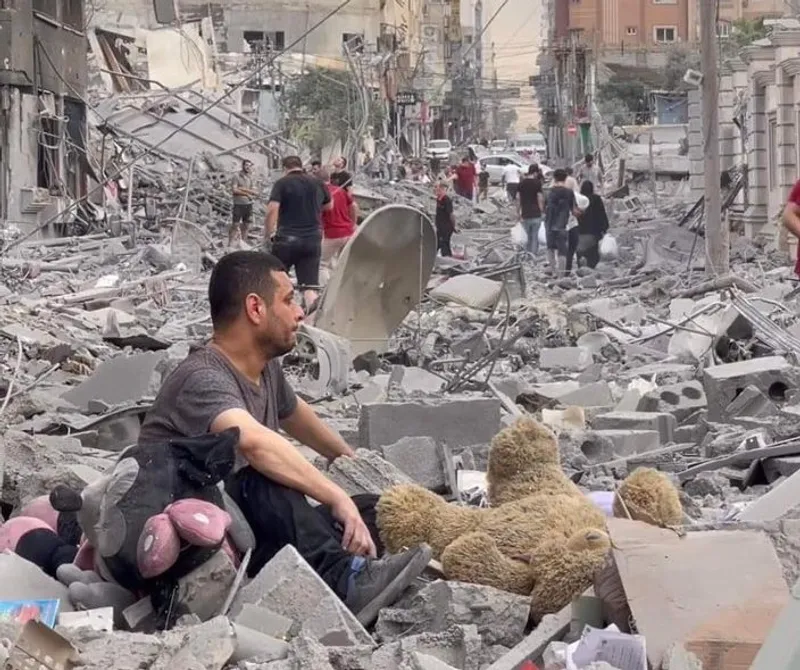
The war has devastated Gaza, claimed the lives of 289 journalists according to the Committee to Protect Journalists, displaced roughly 90% of the population, and triggered a severe humanitarian crisis, including famine in Gaza City.
Pro-Palestinian protests have surged, according to the Armed Conflict Location & Event Data Project (ACLED), rising from 780 across Europe between December and April to 2,066 in the last five months—averaging at least 15 per day. These protests cut across political lines and include significant participation from Europe’s Muslim communities, a key electoral constituency in countries like France and Germany.
In contrast, only 51 pro-Israel protests occurred in the past six months, half of them in Germany, with ACLED data showing a sharp decline in public support for Israel a few months after the conflict began.
Speaking at the UN shortly after Meloni, Netanyahu appeared to acknowledge the shift: “Support for Israel surged immediately after Oct. 7, but it quickly eroded once Israel responded as any self-respecting nation would after such a brutal attack,” he said.
Israel’s Deep European Ties
Israel and the European Union share deep historical and cultural links dating back to the post-World War II era. Most Jewish Israelis trace their heritage either to the broader Middle East or to European Jewish communities destroyed by pogroms and the Holocaust.
“Israel is from Europe. Anyone who doesn’t recognize that doesn’t truly understand this country,” said Sharon Pardo, a Ben-Gurion University professor and author of Uneasy Neighbours, a book on European-Israeli relations.
Strategic considerations also drove Israel toward Europe. Israel’s first prime minister, David Ben-Gurion, prioritized building lasting economic, political, and cultural ties. Today, the EU remains Israel’s top trading partner.
However, Netanyahu’s alignment with far-right European parties has strained relations with the European political establishment. “Netanyahu’s Israel is Euro-sceptic, actively challenging European integration,” Pardo said.
Criticism of Israel Grows Amid Gaza War
Initially, European leaders rallied in support of Israel following the violence of Oct. 7, 2023. EU Commission President Ursula von der Leyen visited a devastated kibbutz days later, pledging EU backing. But almost two years on, Israel’s Foreign Minister Gideon Saar accused her of “empowering a terrorist organization” by urging the EU to press Israel to halt the war.
Von der Leyen argued there has been a “systematic shift in recent months that is simply unacceptable” and called for Europe to take stronger action. Influenced by public protests and critical EU staff, including over 2,000 current employees and 390 former diplomats who signed letters condemning the EU’s Gaza policy, she proposed measures including tariffs on Israeli goods, sanctions against Israeli settlers and two cabinet members, and sanctions on 10 Hamas leaders. EU leaders were scheduled to discuss the proposals in Copenhagen.
Major EU actions require unanimity—challenging in the 27-nation bloc—but some measures can pass via population-weighted votes, requiring support from countries like Italy or Germany.
All Eyes on Meloni and Merz
Germany’s backing of Israel, shaped by its Holocaust legacy, is second only to the U.S. Chancellor Friedrich Merz’s Christian Democrats support Israel, while coalition partners, the Social Democrats, are more critical. Merz has curtailed arms sales but rules out sanctions, even as tens of thousands protest in Berlin demanding an end to the war.
Italy, influenced by trade unions and the Vatican, could tip the balance. Meloni has expressed willingness to join other European nations recognizing a Palestinian state, potentially increasing pressure on Israel over Gaza. Italy has deployed navy ships to protect activist flotillas challenging Israel’s blockade, following reported drone attacks near Greece.
Calls have also intensified to bar Israel from sporting and cultural events. After pro-Palestinian protesters disrupted Spain’s Vuelta cycling race, Spanish Prime Minister Pedro Sanchez suggested Israel be excluded until hostilities end. Some countries have also threatened to boycott the Eurovision Song Contest if Israel participates.