






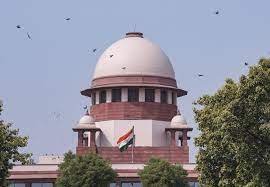
New Delhi: The Supreme Court on Tuesday said it would confine itself to interpreting constitutional provisions while examining the Presidential reference on whether timelines can be imposed on governors and the President for acting on state assembly bills.
A five-judge bench headed by Chief Justice BR Gavai made the observation after Solicitor General Tushar Mehta objected to senior advocate Abhishek Singhvi citing examples involving Andhra Pradesh, arguing he should then file a reply. Mehta remarked that if such examples were pressed, the Centre would respond by highlighting how constitutional provisions had been misused over time.
CJI Gavai, however, clarified, “We are not going into individual instances whether it’s Andhra Pradesh, Telangana, or Karnataka. We will only interpret the Constitution. Nothing else.”
Singhvi, appearing for the Tamil Nadu and Kerala governments, resumed his submissions on the meaning of a bill “falling through.” He explained that this occurs when an assembly, after a bill is returned by the governor under Article 200, chooses not to resend it or abandons it due to a policy change. The bench asked what would happen if a governor withholds a bill without returning it. Singhvi replied that in such cases, previous judgments held the bill lapses unless Article 200’s first proviso is followed, which requires the governor to return the bill to the assembly.
On August 28, the court had already remarked that the phrase “as soon as possible” in Article 200 would be meaningless if governors could indefinitely withhold assent. The Centre had earlier argued that state governments cannot invoke writ jurisdiction against actions of the President or governors, claiming no fundamental rights are violated in such cases.
Article 200 gives governors discretion to assent to, withhold, return, or reserve bills for the President’s consideration. Its proviso requires that once a bill is returned and reconsidered, the governor must grant assent.
On August 26, the bench had also raised concerns on whether governors could indefinitely delay assent, even on money bills, and whether courts must remain powerless in such cases. Several BJP-ruled states countered that governors and the President exercise independent constitutional authority and that “the judiciary cannot be a pill for every disease.”
The Presidential reference stems from May, when President Droupadi Murmu invoked Article 143(1) to seek clarity from the Supreme Court on whether judicial directions could set time limits for governors and the President in dealing with bills passed by state legislatures.