






Sonia Gandhi Criticises Modi Government’s Stance on Palestine, Calls for Leadership
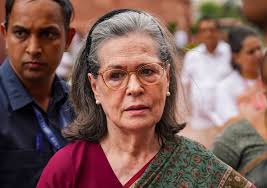
NEW DELHI: Congress Parliamentary Party chairperson Sonia Gandhi on Thursday sharply criticised the Modi government’s approach to the Israel-Palestine conflict, describing it as a “profound silence” and an abdication of both humanity and morality. She argued that India must take a leadership role on the issue rather than letting personal friendships shape its foreign policy.
Gandhi suggested that the government’s stance appears influenced more by Prime Minister Narendra Modi’s relationship with Israeli Prime Minister Benjamin Netanyahu than by India’s constitutional values or strategic interests. “Personalised diplomacy cannot serve as India’s guiding compass,” she wrote in The Hindu, warning that similar approaches elsewhere, particularly in the United States, have failed disastrously.
This marks Gandhi’s third recent article in which she strongly critiques the government’s position on Israel-Palestine. She emphasized that India’s global standing cannot rely on the ambitions of one individual or past achievements but requires consistent courage and historical continuity.
Highlighting international developments, Gandhi noted that France, alongside the UK, Canada, Portugal, and Australia, has recognised Palestinian statehood—“a first step in fulfilling the legitimate aspirations of the long-suffering Palestinian people.” Over 150 of the 193 UN member states have now done so. She reminded that India itself was an early supporter, formally recognising Palestinian statehood on November 18, 1988, after years of backing the Palestine Liberation Organisation (PLO).
Gandhi cited India’s historical leadership on global justice, including its opposition to apartheid in South Africa, support for Algeria’s independence, and intervention in 1971 to prevent genocide in East Pakistan, which led to the creation of Bangladesh. On Israel-Palestine, India has traditionally maintained a delicate but principled stance, prioritising peace and human rights.
“The issue of Palestine is now a struggle for justice, dignity, identity, and human rights,” Gandhi asserted, noting that India has largely retreated from this role since the outbreak of hostilities in October 2023. She condemned the violence, highlighting that more than 55,000 Palestinian civilians, including 17,000 children, have died, and Gaza’s infrastructure—housing, schools, hospitals, agriculture, and industry—has been devastated. Humanitarian aid is being “drip-fed” amid severe shortages, and civilians have even been shot while seeking food.
Gandhi argued that the global response has been slow, effectively legitimising Israeli actions. The recognition of Palestine by several countries, she said, represents a long-overdue assertion of justice, self-determination, and human rights. “In today’s world, silence is not neutrality; it is complicity,” she warned, noting India’s “conspicuously muted” response.
She further criticised India’s recent bilateral investment agreement with Israel and the hosting of Israel’s far-right Finance Minister, who has been widely condemned for inciting violence against Palestinians. Gandhi stressed that India should approach the Palestine issue not just as foreign policy but as a test of its ethical and civilisational values.
“The people of Palestine have endured decades of displacement, occupation, and assaults on their civil and human rights,” she wrote. “Their struggle resonates with India’s own colonial experience. We owe Palestine both historical empathy and the courage to act on it.”