






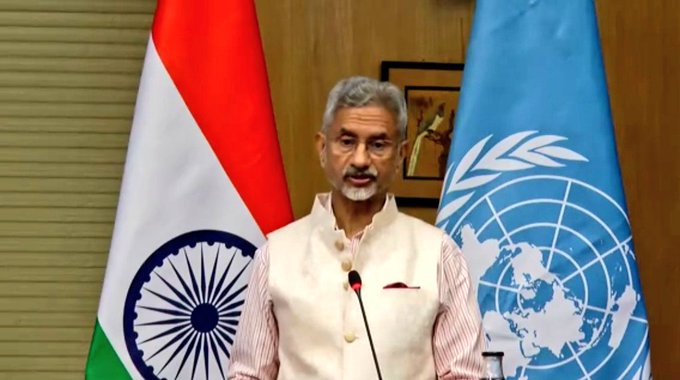
New Delhi: India on Friday highlighted Pakistan’s efforts at the UN Security Council to shield a terror outfit that claimed responsibility for the Pahalgam attack, calling it a stark example of how the global body’s functioning has become “gridlocked” and in urgent need of reform.
External Affairs Minister S. Jaishankar criticised attempts to equate victims and perpetrators of terrorism under the guise of global strategy—an apparent reference to those linking India and Pakistan in the aftermath of the brutal attack.
Speaking at an event marking the 80th anniversary of the United Nations, Jaishankar said that “all is not well” with the UN, noting that its debates have grown “increasingly polarised” and its functioning “visibly gridlocked.”
“Any meaningful reform is obstructed using the reform process itself,” he remarked, adding that the challenge before the world is to sustain the UN while simultaneously reinventing it.
Citing the Pahalgam incident as a telling example, Jaishankar said, “When a sitting Security Council member openly protects the very organisation that claims responsibility for a barbaric terror attack like Pahalgam, what does that say about the credibility of multilateralism?”
Although he did not name Pakistan directly, Jaishankar’s remarks clearly referred to Islamabad.
“Similarly, when victims and perpetrators of terrorism are equated in the name of global strategy, how much more cynical can the world get? When self-proclaimed terrorists are shielded from sanctions, what does it say about the sincerity of those involved?” he asked.
Pakistan, currently a member of the UN Security Council and its chair in July, reportedly tried to remove references to The Resistance Front (TRF)—a Lashkar-e-Taiba proxy that claimed responsibility for the Pahalgam attack—from a UNSC press statement condemning the incident. TRF was also mentioned in a July UNSC report for its role in the attack.
Jaishankar further argued that the UN has failed to address urgent global challenges. “If maintaining international peace and security has become mere lip service, the state of development and socio-economic progress is even more concerning,” he said.
Referring to the slowdown in achieving the UN’s Sustainable Development Goals (SDGs), he noted that it reflected the growing distress of the Global South. “There are many more indicators—trade barriers, supply chain dependencies, and political domination among them,” he added.
Concluding on a hopeful note, Jaishankar urged continued support for multilateralism. “However difficult, our commitment to multilateralism must remain strong. However flawed, the United Nations must be supported in this time of crisis,” he said.
The Sustainable Development Goals (SDGs) are a global framework aimed at achieving a more equitable and sustainable future for all.